Introduction to NetFUNNEL
When Down becomes Wait, NetFUNNEL is with you.
What is NetFUNNEL?
NetFUNNEL is a Virtual Waiting Room–based traffic control solution from STCLab. It controls sudden spikes in user requests in real time so you can run services stably without server failures or outages.
Modern online services see traffic concentrated at specific times. Events like store opens, ticket sales, promotion starts, or popular content releases can bring dozens of times the usual request volume in seconds. Under that load, even healthy servers can suffer response delays, errors, and outages from too many concurrent requests.
Traditional Application Performance Management (APM) focuses on post-incident analysis and response using logs and data after an outage. Recovering user loss and business impact through maintenance alone is difficult, and predicting server stability for the next event is hard.
STCLab and NetFUNNEL take a different approach: prevent incidents before they happen. NetFUNNEL exists not to analyze causes after an outage, but to control traffic in advance so outages do not occur. When traffic exceeds your configured threshold, NetFUNNEL creates a virtual waiting room for end users. Excess users are placed in a first-come, first-served queue and enter the service in order as capacity allows. Because the server receives only as much traffic as it can handle, the system stays within a manageable load and users get a predictable experience.
A Virtual Waiting Room manages an online queue and controls user access so that during peak demand you can deliver a smooth, fair experience.
Learn more in the STCLab Blog: What is a virtual waiting room? How technology prevents access overload.
Why traffic management matters
Traffic is not just system load—it represents user interest, business opportunity, and potential revenue. Issues like connection failures, payment failures, or service unavailability can lead to lost customers and revenue in minutes. Failed traffic management during promotions or peak events can also cause long-term damage to brand trust.
When traffic is managed well, services run smoothly even under heavy load and users have a positive brand experience. That amplifies the effect of marketing campaigns and encourages users to stay longer and explore more products or content. If you have had server issues before, a better experience can restore trust and turn into repeat visits and long-term customer relationships.
STCLab knows that traffic is an asset that directly drives business results. NetFUNNEL protects the server and maximizes business value while avoiding loss of that traffic.
System architecture
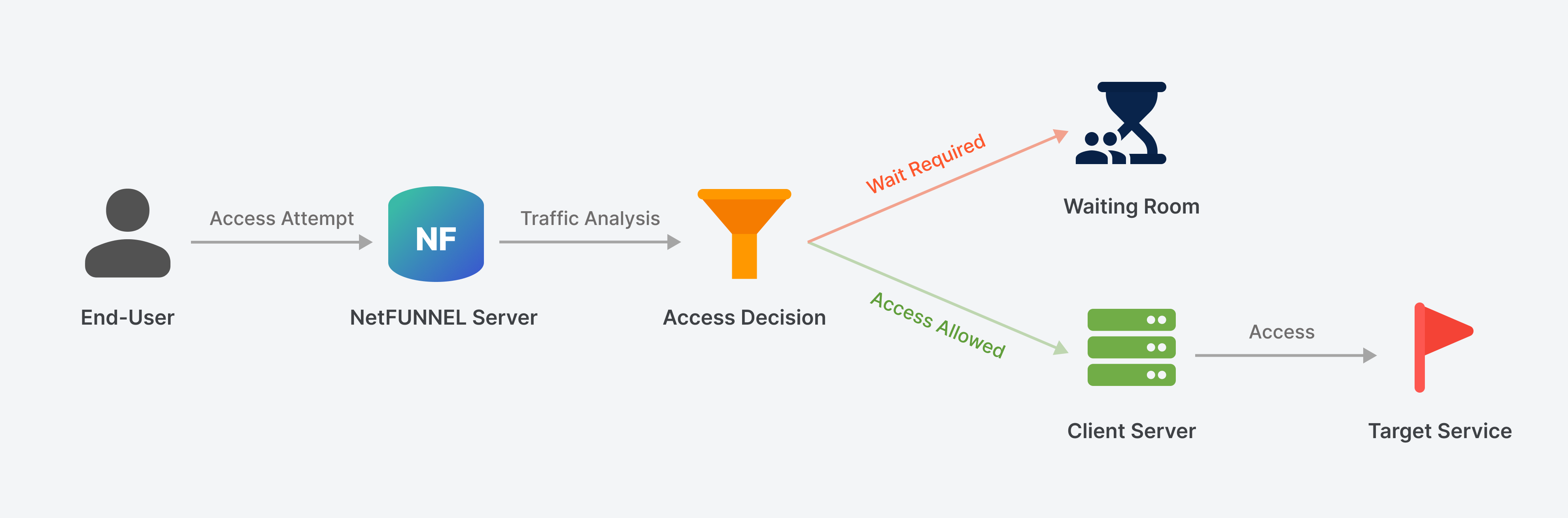
NetFUNNEL works by deploying a lightweight agent in your environment. It can be applied on Web, Android, iOS, and other platforms with minimal change to your service architecture, reducing impact on existing systems. Operators can define traffic-controlled pages by setting trigger rules by URL, domain, or path. You can also apply fine-grained traffic control to specific sections instead of the entire service.
Agents keep the current system state up to date through TTL (Time-to-Live) based communication. NetFUNNEL uses your configured concurrent entry limit to decide whether to allow or queue each user. The entry limit can be changed in real time during operation, and changes take effect immediately without redeploying the app or stopping the service.
When users visit your site or app, the NetFUNNEL agent loads and initializes automatically. The agent checks control conditions according to the configured control mode, then talks to the NetFUNNEL server to compare current traffic with your thresholds and decide whether the user can enter.
If traffic is over the threshold, users are sent to the virtual waiting room. There they see their queue position and estimated wait time, and can follow real-time updates while waiting. When capacity is available, they are redirected to the service page in queue order and can use the service normally after waiting.
When the server has capacity, users enter the service page immediately without waiting. They can use the service as usual, and NetFUNNEL keeps monitoring traffic in the background to support stable operation.
Key features
Real-time traffic control
NetFUNNEL accepts and controls all traffic based on the server’s manageable entry limit. Before overload occurs, it assigns an order to each request and decides immediately whether to allow entry or queue, keeping the service stable.
NetFUNNEL can be applied via trigger-based control (UTI) or code-based control (CBI). Trigger-based control is easy to change at runtime; code-based control lets developers tailor behavior to business logic.
Control modes are basic control and section control. Basic control manages access at a single entry point; it suits cases like event pages or ticket sales where you need quick rollout, and works with both UTI and CBI. Section control keeps a user session from a start point to an end point and limits concurrent users in that section; it supports stable handling of multi-step flows like cart to checkout and is available in CBI.
NetFUNNEL lets you choose the right control mode for your environment and service, enabling traffic operation optimized to the situation, not just blocking traffic.
Customizable waiting room

Users in the waiting room see their queue position and estimated time in a modal, so they get a stable, predictable experience instead of an endless loading screen.
The waiting room is made up of pre-waiting room, main waiting room, and post-waiting room. With reservation you can cover pre-event registration, real-time waiting during the service, and post-event traffic—the full lifecycle. Email, sound, and popup notifications help users not miss the moment they can enter. A live message area in the waiting room lets you push updates and announcements in real time and reduce confusion.
NetFUNNEL lets you customize the waiting room to match your brand and goals. You can use simple console settings or full customization via code; changes apply in real time.
A well-designed waiting room can act as a communication channel, not just a queue. Brand messages, event info, and recommended content can create upsell and cross-sell opportunities and lead to longer session time and more revenue.
Traffic monitoring
NetFUNNEL observes all traffic entering the system and uses a strong analytics engine to give insights for traffic operation. Operators can see key metrics in real time—request volume, queue size, wait time, entries, resource usage—and react quickly to traffic and control effectiveness.
Together with traffic control monitoring, real-time EUM (End User Monitoring) gives a precise view of the end-user experience. That goes beyond raw numbers to quickly find traffic hotspots and causes of poor experience and keep service quality stable.
Ready to turn traffic into an asset? Contact our sales team.